AI Does the Work. People Decide What Matters
AI is removing traditional junior work while allowing junior people to contribute earlier. The real challenge is rebuilding judgment, apprenticeship, and accountability around that shift.
July 19, 2026
Over the past few months, two apparently contradictory stories have taken hold.
One says AI is removing the work traditionally done by junior people.
The other says some companies are hiring more junior people because AI allows them to contribute much earlier.
Both can be true because the job itself is changing.
The junior job is not simply disappearing. The routine tasks are shrinking while the expectations are rising. Junior people are being asked to exercise judgment, work with AI, and engage with real problems earlier in their careers.
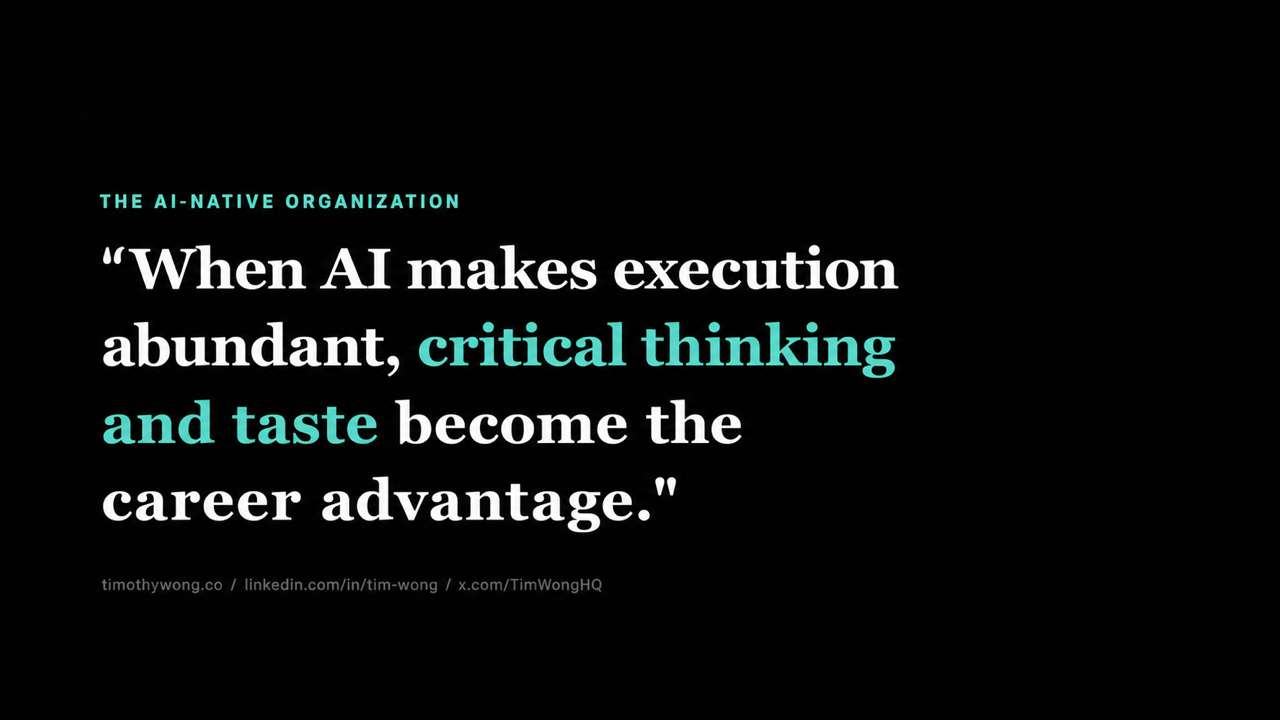
That tension is one part of a much larger change in how organizations value people. When AI makes execution abundant, producing more is no longer enough. The scarce human capabilities move upstream: deciding what deserves attention, questioning what appears plausible, setting a quality bar, and taking responsibility for the result.
Critical thinking and taste become the real people strategy.
Trend 1: Entry-level hiring may rise while apprenticeship disappears
The old junior role bundled two things together:
- Low-risk execution that created leverage for senior colleagues.
- Repetition through which the junior person learned the domain.
AI can absorb much of the first category: initial research, basic analysis, first drafts, routine code, meeting synthesis, and standard reporting. That can improve the economics of hiring a junior person. One capable graduate with the right tools can contribute to real work much earlier.
But it also removes the practice ground on which judgment used to develop.
This explains why the evidence can point in both directions. Employers may hire more graduates while expecting them to operate at a higher level from day one. New entry-level roles increasingly emphasize systems thinking, critical analysis, human oversight, and earlier exposure to real clients.
The headcount can grow even as the definition of entry-level changes.
The unresolved question is whether companies can demand more judgment from juniors while removing the experiences that once produced it.
Trend 2: Domain experts are becoming builders
The second trend is the collapse of the boundary between using a system and building one.
A finance leader can now prototype a reconciliation workflow. A recruiter can create a sourcing agent. A sales operator can build account research and qualification flows. A product manager can move from a written specification to a working prototype without waiting for a full delivery team.
Functional leaders are increasingly expected to become technology experts in their own domains. One emerging operating model is a domain expert managing a team of agents rather than a manager coordinating ten narrowly specialized humans.
The limiting factor is no longer whether a person can express an idea in code. It is whether they understand the domain well enough to recognize a correct result.
That makes domain expertise more valuable, not less. AI lowers the technical floor for creation, but it raises the premium on context, problem selection, and evaluation.
Trend 3: Engineering moves toward the last mile
If more people can build, engineering does not become irrelevant. Its center of gravity changes.
The difficult work moves from producing the first version to making the system dependable:
- integrating it with real data and workflows
- defining permissions and failure boundaries
- evaluating quality across edge cases
- monitoring behavior in production
- making performance, cost, and security acceptable
- deciding where a human must remain accountable
The scarce engineering capability is increasingly not isolated model or software creation. It is the ability to embed an imperfect probabilistic system inside a consequential organization.
Building is becoming cheaper. Delivery, integration, and trust are becoming more expensive.
Trend 4: The organization is becoming the bottleneck
Most companies still treat AI adoption as an individual productivity program: give employees tools, offer training, and count usage.
This framing is too shallow. AI adoption depends as much on culture, management, and talent practices as it does on individual effort. Yet many employees are still asked to reinvent how work gets done inside systems that reward the old way of working.
The employee may be ready before the organization is.
People are told to use AI, but goals still reward the old workflow. Managers ask for experimentation, but performance systems punish uncertainty. Teams generate more output, but decision rights, review capacity, and accountability remain unchanged.
This is why high tool usage can coexist with disappointing business results. The constraint has moved from capability to allocation: which problems receive attention, which context an agent receives, who reviews the result, and where authority stops.
Why these trends are happening
All four trends come from the same underlying shift: execution is becoming abundant.
An organization can now generate more analysis, code, campaigns, prototypes, and recommendations than it has the capacity to evaluate or absorb. More output does not remove scarcity. It relocates it.
The new scarcities are:
- Attention: Which problem is worth solving now?
- Context: What does the system need to know that is not in the prompt?
- Verification: What evidence would prove the answer wrong?
- Taste: Is this merely acceptable, or is it actually good?
- Accountability: Who owns the consequence when the system is wrong?
This is why critical thinking and taste matter more as AI improves.
Critical thinking is the ability to interrogate an answer: identify assumptions, test evidence, expose uncertainty, anticipate failure, and distinguish a convincing output from a correct one.
Taste is the ability to direct the work: choose a worthwhile problem, set the quality bar, make coherent tradeoffs, remove what does not belong, and know when the last 10% changes the entire outcome.
Critical thinking asks, “Is this true, safe, and applicable?”
Taste asks, “Is this worth making, and is it good enough?”
Neither is a decorative soft skill. Together, they are the control system for abundant machine execution.
What changes inside the organization
Hiring should test judgment, not AI theater
As access to AI becomes universal, asking whether a candidate can use it tells us very little.
A better hiring exercise gives the candidate an ambiguous business problem, access to AI, and imperfect information. The evaluation should focus on how they frame the problem, what they question, which evidence they seek, what they reject, and how they improve the result.
The artifact matters. The reasoning and quality bar matter more.
Performance should reward outcomes and reusable leverage
Activity metrics become less meaningful when machines can generate activity at negligible marginal cost.
The better questions are:
- Did the work improve a customer or business outcome?
- Did the person create a reusable system rather than a one-time answer?
- Did they catch a plausible but dangerous mistake?
- Did they improve the team’s ability to make future decisions?
- Did they know when not to automate?
Good judgment often appears as work that was stopped, narrowed, or redesigned. A performance system focused only on visible production will miss it.
Managers should become designers of work
The manager as information relay is losing value. The manager as work designer becomes more important.
Managers need to decide which decisions can be decentralized, where review is required, how teams learn from failures, and how people develop judgment rather than merely supervise outputs. They also need enough taste to recognize when a technically valid result is strategically incoherent.
Apprenticeship must become deliberate
This is the most important implication of the junior-hiring data.
If foundational tasks disappear, organizations must replace accidental apprenticeship with designed apprenticeship. Juniors need earlier exposure to real customers, ambiguous problems, decision reviews, failure analysis, rotations across adjacent functions, and explicit feedback on why one answer is better than another.
AI also creates a new layer of work around the system itself: curating source data, annotating edge cases, constructing eval sets, inspecting agent traces, classifying failure modes, challenging automated graders, routing exceptions, and monitoring whether performance drifts in production.
This is not optional support work. Production AI requires teams to test data sources and transformations, compare outputs against ground truth, combine automated evaluation with human oversight, and involve practitioners in testing. One emerging operating pattern is for dedicated eval teams to own the infrastructure while domain experts and product teams contribute the test cases and run the evaluations.
Some of this can become the new apprenticeship layer for junior people. A junior analyst can curate representative cases, annotate them against a calibrated rubric, review failure traces, maintain evaluation data, and investigate disagreements between human and machine judgments. Done well, this exposes the junior person to precisely the boundary cases through which domain judgment develops.
But annotation is not automatically apprenticeship. If a junior person is asked to click labels without context, they learn very little and the work is itself vulnerable to automation. The developmental model pairs them with experienced domain experts: seniors define and calibrate what good looks like; juniors help test it at scale; disagreements become teaching moments; and both improve the system.
For an enterprise, the valuable human-in-the-loop work is therefore not merely producing more labels. It is converting tacit domain knowledge into data, evals, escalation rules, and an explicit quality bar. This is where critical thinking and taste become operational rather than abstract.
Critical thinking and taste are not traits that companies can simply purchase from the labor market. They are developed through context, consequences, comparison, and coaching.
A company that automates the learning ladder and then complains that junior people lack judgment has designed its own talent shortage.
My interpretation
AI is not eliminating people in one clean movement. It is relocating human value.
Value moves away from routine production and toward problem selection, verification, integration, quality, and accountability. This can increase the leverage of senior people. It can also make junior people productive earlier. But it creates a dangerous mismatch if organizations raise the bar for judgment without rebuilding how judgment is learned.
The optimistic reading of the junior-hiring statistics is that AI can expand opportunity. The more critical reading is that companies may be renaming mid-level expectations as entry-level roles.
The outcome depends on organizational design.
The best companies will not merely add agents to the existing hierarchy. They will redesign decision rights, career paths, management, performance, and apprenticeship around a new division of labor:
- machines generate and execute at scale
- people choose, question, integrate, and own
This is the emerging people model for an AI-native organization.
Not fewer people by definition. Not more people by default. Different people systems, built around a different source of scarcity.
The organizations that win will not be those with the most agents. They will be those whose people know what to question and what is worth making.
Operating principle: Decentralize creation. Centralize accountability.
Part of the Building an AI-Native Organization series. The pillar article introduces the full operating model.